


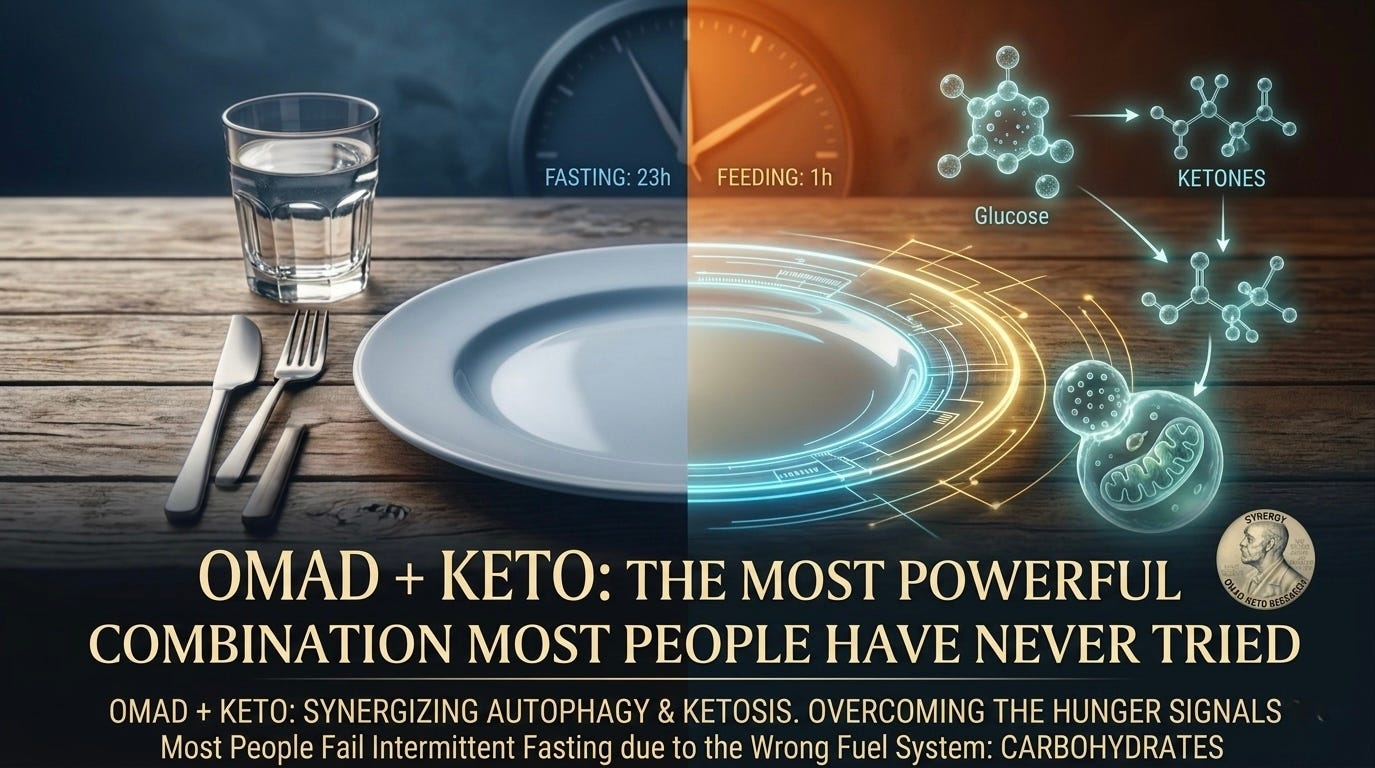
Most people who try fasting give up.
Not because fasting is hard.
Because they are still eating carbohydrates.
The Problem With Fasting Alone
When you eat carbohydrates, your body burns glucose for fuel.
When glucose runs out — usually within a few hours — hunger signals activate.
Strong ones.
This is why most people fail at intermittent fasting. Not lack of willpower.
Wrong fuel system. Most people who try fasting give up.
Not because fasting is hard.
Because they are still eating carbohydrates
What Ketosis Actually Is
The ketogenic diet shifts your body’s primary fuel source from glucose to fat.
When carbohydrates are restricted to approximately 20–50g per day, the liver begins converting fat into ketones.
Ketones are a cleaner, more stable fuel source than glucose.
No spikes. No crashes.
No hunger two hours after eating.
This is not a diet trend.
It is your body’s original backup fuel system — the one humans relied on for most of their existence.
Why Keto Makes OMAD Easy
Here is what changes when you combine keto with OMAD:
Hunger disappears.
Fat-adapted bodies do not experience the glucose crash that triggers intense hunger signals.
Energy stabilizes.
Ketones provide consistent fuel throughout the fasting window.
No afternoon energy crash.
No brain fog.
Cravings stop.
Without blood sugar fluctuations, the psychological pull toward snacking and frequent eating largely disappears.
OMAD becomes the natural result — not a discipline exercise.
The Autophagy Connection
Both fasting and ketosis independently activate autophagy.
Combined, the effect is amplified.
Fasting drops insulin.
Ketosis keeps insulin low.
Low insulin is the primary signal that activates autophagy.
OMAD + keto means:
23 hours of fasting per day, combined with a metabolic state that mimics fasting even during the eating window.
This is the most sustained autophagy activation available without medical intervention.
What One Meal Looks Like
The concern most people raise:
can one meal provide adequate nutrition?
With keto, yes — more easily than with a standard diet.
A single OMAD keto meal contains:
High-quality protein — meat, fish, eggs.
Healthy fats — olive oil, avocado, nuts.
Low-carb vegetables — leafy greens, broccoli, cauliflower.
Dense nutrition. No empty calories.
No processed fillers.
One meal. Completely adequate.
Just 1/3 of regular meal cost per month.
20 Years of Evidence
I did not design this combination from research.
I arrived at it through practice, then found the science that explained what was already working.
Twenty years of OMAD + keto.
No chronic disease.
No medications.
No gym membership.
Consistent energy. Stable weight.
Low food costs.
The combination works.
Not in theory.
In practice.
Next issue: The economics of OMAD —
how one meal a day changes your relationship with food costs, healthcare, and financial independence.
expaTORU — Practicing OMAD for 20+ years.
Author of OMAD Longevity Series
Series 1
OMAD: Health & Longevity — A Practical Guide
Series 2
OMAD: Hunger Myth - Debunking 8 Hunger Myths
Series 3
OMAD: Fasting Myth - Why Intermittent Fasting Isn’t Working
Series 4
OMAD Calorie Myth - Why Calories Don’t Matter For Diet And Weight Loss
Series 5
OMAD - Healthspan Myth - The Diet That Extends Your Lifespan
Series 6
OMAD Allergy Myth - The Synergy Of Ketogenic Diet And Gut Health
Series 7
OMAD - Cholesterol Myth - Why Was The Cholesterol Made The Villain?
Series 8
OMAD Obesity Trap - The Vicious Cycle Of Obesity
Series 9
OMAD Fat Myth - Everything You Know About Fat Is Wrong
Series 10
OMAD Low Carb Myth - The Hidden Truth About Ketogenic Diet
Series 11
OMAD Diet Myth - Fail-Safe Intermittent Fasting For Healthy Longevity
Series 12
OMAD Nutrition Health - Your Nutrition Is Based On Yesterday’s Guidelines
Series 13
OMAD Protein Myth - Eat Real Food: Make Protein Your Main Dish
Series 14
OMAD Fiber Myth - The Hidden Gem Of Carbs
Series 15
OMAD Complete Meal - A Complete Nutrition Recipe For OMAD And Keto Diets
Available on Amazon