


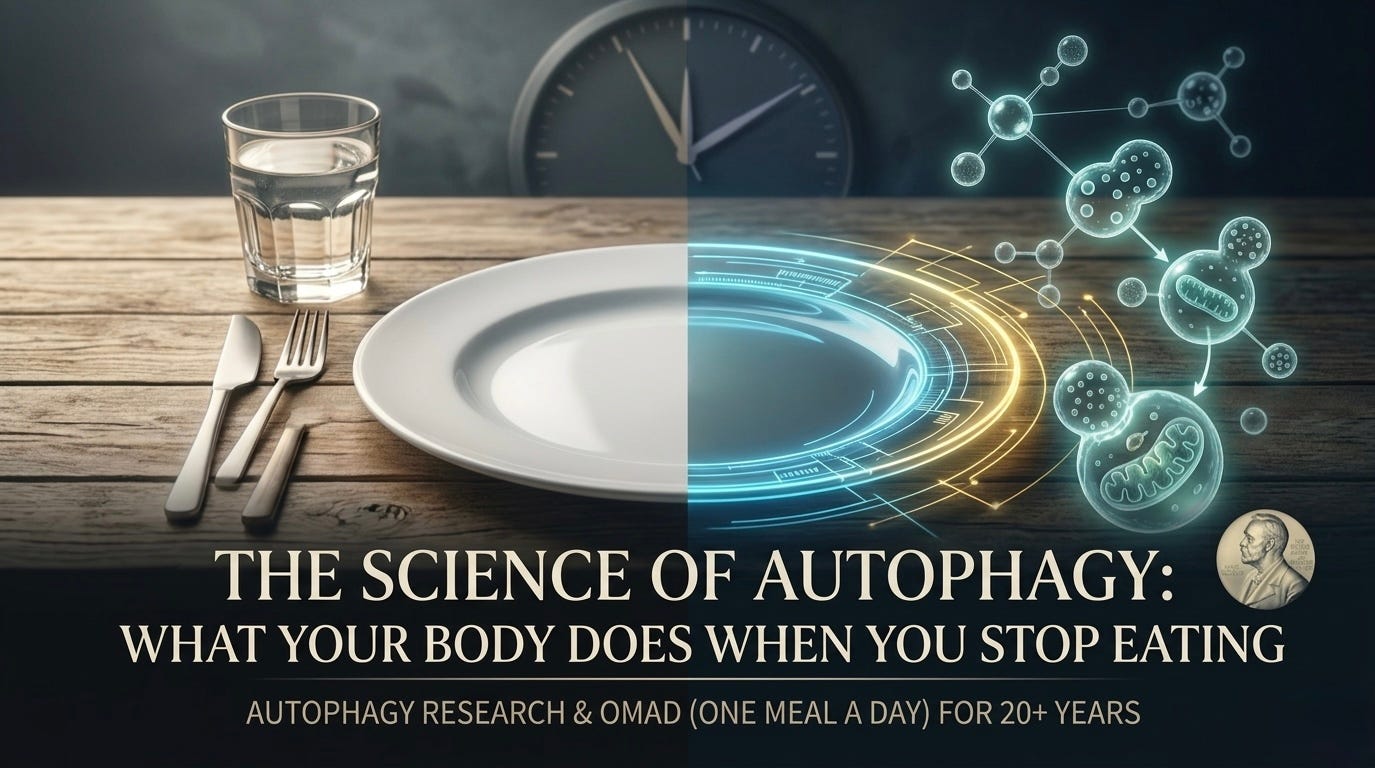
Most diets tell you what to eat.
This one is about what happens when you don't.
In 2016, Yoshinori Ohsumi won the Nobel Prize in Physiology or Medicine.
Not for discovering a new drug.
Not for inventing a new treatment.
For explaining what your body already does — naturally — when you give it enough time without food.
That process is called autophagy.
What Is Autophagy?
The word comes from the Greek: auto (self) + phagein (to eat).
Literally: self-eating.
When your cells are deprived of nutrients for long enough, they begin breaking down and recycling their own damaged components.
Misfolded proteins. Dysfunctional mitochondria. Cellular debris that would otherwise accumulate and cause disease.
Think of it as the body's internal cleaning system.
Not a supplement.
Not a drug.
Not a treatment.
A biological process that has existed for as long as humans have.
When Does Autophagy Begin?
This is where OMAD becomes relevant.
Research suggests autophagy begins to activate after approximately 16–18 hours of fasting.
By hour 20–23 — the window most OMAD practitioners reach every day — it is running at full capacity.
Three meals a day, eaten every 4–5 hours, never allows this process to fully activate.
Insulin — released every time you eat — is the primary suppressor of autophagy.
The math is simple: fewer meals = lower insulin = more autophagy.
What Does Autophagy Actually Do?
The research on autophagy links it to:
Longevity
Cells that clean themselves regularly age more slowly.
Cancer prevention
Autophagy removes pre-cancerous cells before they replicate.
Neurological protection
Linked to reduced risk of Alzheimer's and Parkinson's disease.
Metabolic health
Reduces chronic inflammation, improves insulin sensitivity.
Weight regulation
The body breaks down fat stores during extended fasting.
None of these are fringe claims.
These are the findings that earned a Nobel Prize.
Why This Matters for OMAD
I did not start OMAD because of the science.
I started because it worked.
When Ohsumi's research became mainstream, I recognized the mechanism behind what my body had been doing for over 20 years.
The science did not change my practice.
It explained it.
If you eat one meal a day, you are activating autophagy every single day.
Not occasionally. Not as a special protocol.
As a daily biological rhythm.
That is the difference between OMAD and every other approach to health I have encountered.
Next issue: How the ketogenic diet
amplifies autophagy — and why OMAD + keto is the most powerful combination most people have never tried.
expaTORU — Practicing OMAD for 20+ years.